
Agentic SaaS Business Architecture
A five-part guide to designing AI-agent products as a business: architecture, go-to-market, pricing, and the people every agent touches.
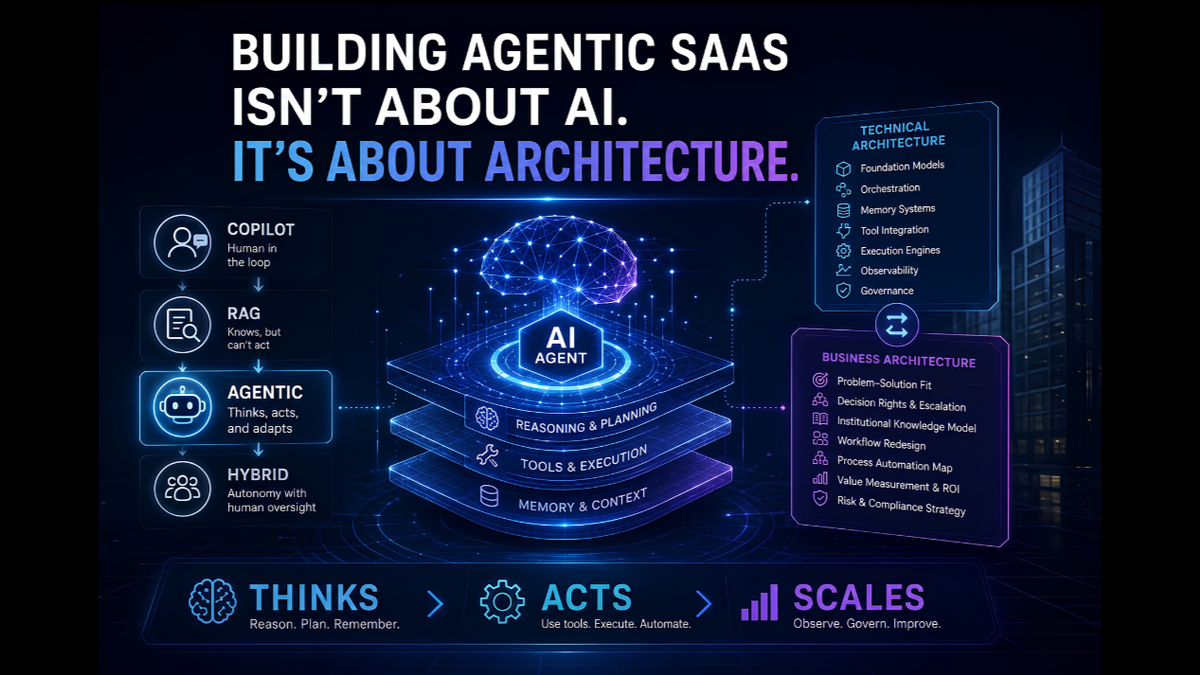
The complete series
Most agentic AI projects don’t stall because the technology fails. They stall because the technology and the business were designed separately: an agent that works in the demo but has no market, no pricing logic, and no plan for the people it changes.
This series designs them together. Five parts, in the order the decisions actually happen:
Architecture → Go-to-market → Pricing → The people it touches
Who it’s for: SaaS and ISV founders, product leaders, CS and revenue leaders building or buying AI agents.
Time: about 60 minutes in total, or one part a week.
The series at a glance
| Question it answers | Key idea | |
|---|---|---|
| Part 1 · Blueprint | What does an agentic product need underneath it? | 7 layers, designed twice: once technically, once as a business |
| Part 2 · Go-to-market | Who buys it, and how do you sell it? | Value follows what the agent does on its own, not how many seats use it |
| Part 3 · Pricing | What do you charge for? | Five pricing tiers, from per-agent to per-outcome |
| Parts 4–5 · Connected Tissue | Who else does it affect? | Visibility before action, accountability after |
Part 1 · The Blueprint
The foundation of the series: a seven-layer blueprint grouped into three stages (THINKS, ACTS, SCALES), with every technical layer paired to the business question it raises. Includes real-world failures at each layer and five questions to ask before your next sprint.
18 min read · Start here
Part 2 · Go-to-market
Your Architecture Might Be Ready for Agentic SaaS. Is Your Go-to-Market? →
Why traditional SaaS playbooks miss how agents create value. Covers market design (deployment architecture as segmentation, three buyers and three conversations), the go-to-market motion, and five leading indicators that show whether it’s working, with a diagnostic you can run.
13 min read
Part 3 · Pricing
Your GTM Might Be Ready for Agentic SaaS. Is Your Pricing? →
What to charge for, and why a pricing model can be mathematically right and still drive away your largest customers. The five-tier progression, choosing your metric, the “success tax”, migrating an existing customer base, and layered-cake pricing.
16 min read
💡 Prefer shorter reads? Part 3 is also available as two 7-minute pieces:
How to Price an AI Agent,
Part 1: What to Charge and How to Prove It
Part 2: Why It Can Be Mathematically Right and Still Backfire
Part 4 · The Connected Tissue (1 of 2)
Who Else Gets Touched When You Deploy an Agent? →
An agent changes more roles than the team that approved it. Maps the ripple effects across teams, the Replace / Assist / Compress spectrum, and why people need to see what an agent did before they act on it, not just afterwards.
7 min read
Part 5 · The Connected Tissue (2 of 2)
Who Absorbs the Risk When an Agent Gets It Wrong? →
Where agents shouldn’t go, why “the agent said it, not us” is no defence, and what rebuilds stakeholder trust after a failure. Closes the series with the questions every deployment team should ask.
7 min read
The frameworks in this series
- The 7-Layer Business Architecture: THINKS (layers 1–3) · ACTS (4–5) · SCALES (6–7)
- The Pricing Tier Progression: per agent → per input → per activity → per output → per outcome
- Layered-cake pricing: stacking simple pricing methods instead of forcing one to do everything
- The Impact Spectrum: Replace · Assist · Compress
- Value × Controlled Risk: a stakeholder acceptance model for agent deployment