Agentic Customer Success System
Proactive Coverage, Without the Headcount Math
Most AI in customer success improves how one person works. Almost none of it compounds into something the organization can measure. Here's what changes when the system is built to close that gap.
The gap isn't the tools. It's what happens after them.
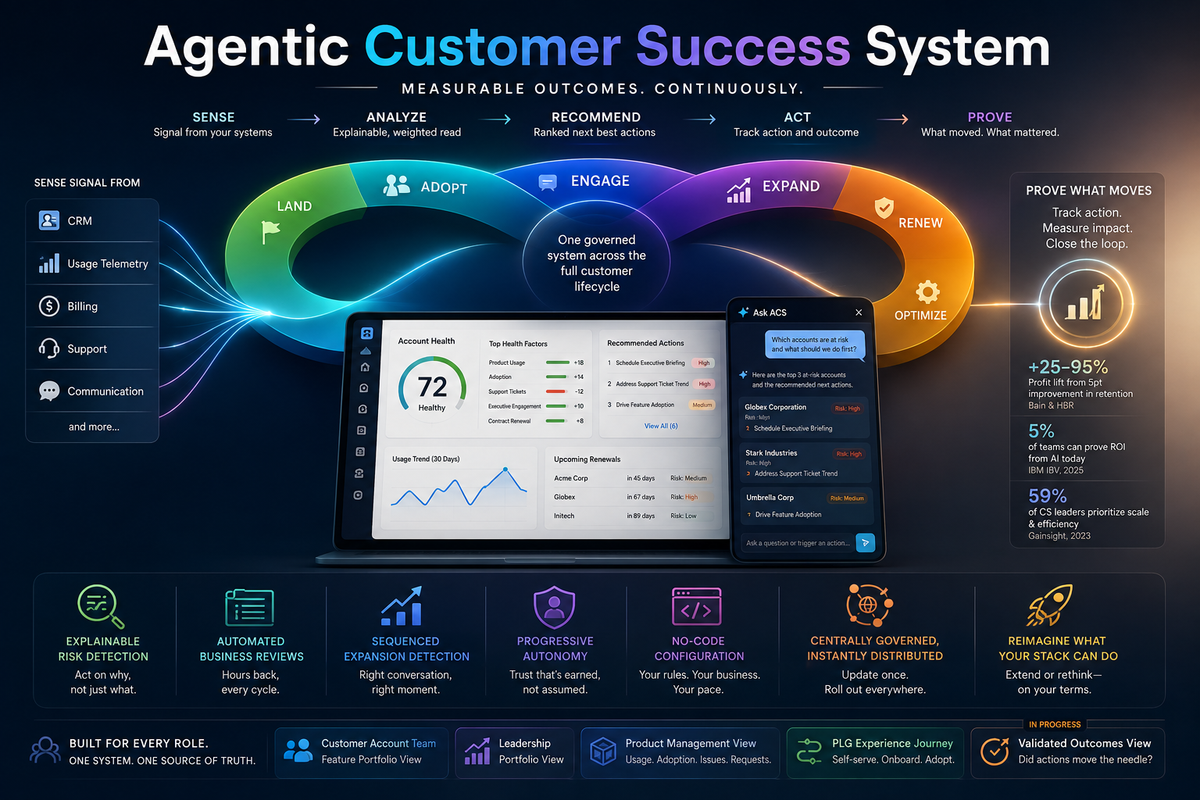
Every CS team today has AI somewhere in the stack — an assistant, a copilot, a point solution bolted onto an existing platform — and the individual productivity gains are real. But most of it never reaches the P&L: 95% of enterprise GenAI pilots deliver zero measurable impact there (MIT/NANDA, 2025), and while 79% of teams report productivity gains, only 5% can show actual ROI (IBM IBV, 2025). The pattern holds inside CS specifically: 59% of leaders name scale and efficiency their top objective, but only 27% have the KPIs to prove they're moving it (Gainsight, 2023). The tools work. What's missing is a system that turns individual output into organizational, measurable outcome.
Why this, why now
The economics make the timing case on their own. A 5-point improvement in retention can grow profit 25–95% (Bain & Company / Harvard Business Review) — few levers carry that much force. The Customer Success platform category is projected to grow from roughly $2.9B to $10.8B, and most of that category has consolidated around the same real strength: visibility — dashboards, health scores, reporting, done well and broadly available. What's still open, industry-wide, is the step after the dashboard: turning what's visible into action that's tracked, and action into a result that's proven. That gap is where the opportunity sits, and it's a first-mover window measured in one to two years, not a decade.
From insight to outcome
So what actually happens after the dashboard is read? For most teams, honestly — it depends who remembers, and nobody circles back to check if it worked.
The Agentic Customer Success System is built around a different loop, run continuously across every account: it senses signal from the systems already in place — CRM, usage telemetry, billing, support, communication — analyzes it into an explainable, weighted read (never a black-box score), recommends a short list of ranked next actions, and then does the part most systems skip entirely: tracks whether the recommendation was acted on, and whether the underlying metric actually moved afterward. Outputs are a vanity metric. Validated outcomes are the point.
It runs as one governed, composable system across the full customer lifecycle — Land → Adopt → Engage → Expand → Renew → Optimize — with capabilities mapped to whichever role is best positioned to act. Sales, Customer Success, Technical Success, and Architecture all draw from the same signal, the same system, the same source of truth.
Benefits, by feature
- Explainable risk detection → faster, more confident decisions. Every health or churn signal comes with the factors driving it, so the team acts on why, not just what.
- Automated business reviews → hours back, every cycle. QBR decks build themselves from live account data — no more assembling slides the night before.
- Sequenced expansion detection → growth conversations that land. Whitespace and upsell signals are checked against account health first, so the pitch happens at the right moment, not the wrong one.
- Progressive autonomy → trust that's earned, not assumed. Every capability starts human-approved and only gains independence as impact, track record, and reversibility support it.
- No-code configuration → your rules, your business, your pace. Built and maintained on no-code platforms like Amazon Q Desktop or Claude Cowork — no engineering dependency to change a rule, add a signal, or adjust an action. The people who make the decisions are the same people who configure the system.
- Centrally governed, instantly distributed. Skills are maintained outside the application, as versioned business logic — so a process or policy update made once rolls out everywhere immediately, owned by the business decision-makers closest to it, not queued behind an engineering release cycle.
- Reimagine what your stack can do → on your terms. Whether that means extending the CS platform already in place, or rethinking what's possible without one — the choice, and the pace of it, stays yours.
However you like to work with it
This isn't a dashboard-only system — it's a conversational one that happens to also render as a view when that's useful. Ask it a question in plain language and trigger a capability directly, or open a consolidated view and work visually. Same system either way — which one you reach for is entirely your call.
Four views are live today, each built for a different seat at the table — with a fifth underway:
- Customer Account Team — Feature Portfolio View → the day-to-day operating view for the team closest to the account
- Leadership — Portfolio View → a rolled-up read across territory or region, built for coverage and risk triage at scale
- Product Management View →what's actually happening inside the system: usage, adoption, incidents, and feature requests
- PLG Experience Journey → the self-serve onboarding and adoption path baked directly into the product
- Validated Outcomes View (in progress, not yet live) → closes the loop all the way: did an accepted, rejected, or completed recommendation actually move the underlying score, not just whether it got done
This system is already built by me and pilot ready, being tested across real account coverage.