Sales Wins the Customer. CS Grows It.
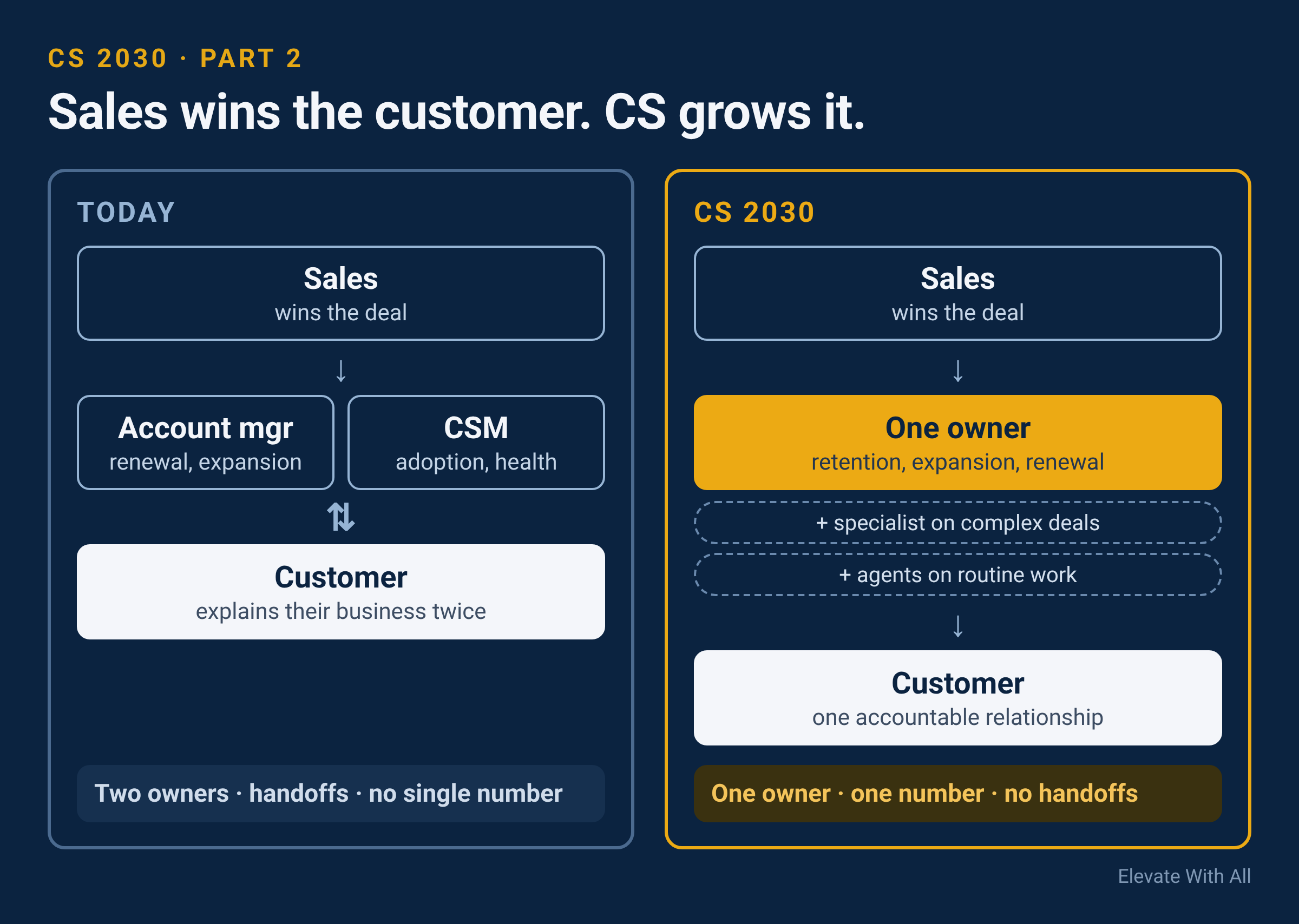
Every existing customer needs one owner for retention, expansion and renewal, built from the best of the CSM and account manager roles.

Part 2 of 9 · CS 2030 series
At the end of a quarterly review, the customer's VP of Operations asks a simple question: "We want to roll this out to three more business units. Who do I talk to?" (A composite, but a familiar one.)
The CSM says, "Great, let me loop in our account manager." The account manager asks the CSM for usage data. The CSM asks the customer for their rollout plan. Two weeks later, the customer's procurement team has budgeted for a competitor's pilot in one of those units.
Nobody did anything wrong. The design did.
In 30 seconds
- The problem: after signature, most SaaS companies split the customer across two or more owners, so growth signals get lost between them.
- The evidence: in ChurnZero's 2024 survey of 1,027 CS leaders, renewals and expansion were owned by four different teams, and the companies with the highest net revenue retention (NRR) more often gave expansion to a commercial owner.
- The fix: give every existing customer one owner for retention, expansion and renewal, built from the best of the CSM and account manager roles.
The split was built for software sold once
The account manager and CSM split comes from perpetual licenses. You sold the software once, renewed maintenance each year, and treated expansion as a new sale. Commercial work and adoption work happened at different times, so different people did them.
Subscription and consumption pricing ended that separation. Every month of usage is a renewal decision in slow motion, and expansion follows adoption. The conversation that proves value is the same conversation that grows the account. Split it across two people, and the customer explains their business twice.
I've seen the same split in SAP transformation programs, between the team that sells the program and the team that delivers it. The handoff is where the customer's next need goes unheard.
Ownership is already moving. The design isn't.
ChurnZero's 2024 study shows who owned each motion that year:
| Motion | Customer Success | Account management | Sales | Renewals team or other |
|---|---|---|---|---|
| Renewal | 51% | 21% | 8% | 19% |
| Expansion | 41% | 29% | 24% | 6% |
Two things stand out. First, at many companies, the person who renews the customer is not the person who grows it. Second, the trend runs toward post-sale owners: between 2022 and 2024, sales' share of expansion fell from 33% to 24%, and the share of CS leaders reporting to a chief revenue officer rose from 17% to 33%.
Rule: if renewal and expansion sit with different people, fix that before you change pay.
The best-retaining companies hire for commercial skill
There's a finding in the same study that cuts against an easy "give it all to CS" story. At companies with NRR of 111% or more, CS owned expansion 35% of the time and account management 40%. At companies at or below 80% NRR, it was 56% CS and 17% account management.
It's a correlation from one vendor survey, and struggling companies often push expansion onto CS as a fix. But the signal is clear enough: expansion rewards commercial skill. Building a business case, handling procurement and negotiating terms are account management strengths.
So convergence isn't CS absorbing account management. It's one role built from both: the CSM's trust and product depth plus the account manager's commercial muscle.
Rule: design the role around both skill sets, and hire or train for whichever one is missing.
Three ways to give the customer one owner
Every model passes the same test: one named person is accountable for the customer's total revenue, and nobody can say "that's not my number."
| Model | How it works | Best fit |
|---|---|---|
| Single owner | One owner holds retention, expansion and renewal for their book, with a commercial target | Mid-market and high-velocity; expansion is mostly seats, usage or the next tier |
| Owner plus specialist | The owner holds the relationship and the number; a specialist joins complex deals and is paid on the assist | Enterprise; new product lines or multi-year agreements |
| Segment owner plus agents | A pooled team owns a segment's number, with digital and AI-assisted engagement; accounts showing expansion signals move to a named owner | High-volume long tail where named coverage isn't economical |
The model can differ by segment. The principle can't.
My view: by 2030, the person who owns the existing customer will be a CSM with a commercial number, supported by specialists and agents, not split across two job titles. If companies that keep the split keep outperforming on NRR, I'll rethink that.
From the CS 2030 Toolkit: Customer Ownership Model (sample)
The model maps every post-sale touchpoint, assigns one accountable owner per customer and defines when a specialist joins. Two illustrative accounts:
| Account C (mid-market) | Account D (enterprise) | |
|---|---|---|
| Post-sale contacts today | CSM, account manager, renewals desk | CSM, account manager, solutions, renewals, executive sponsor |
| Model | Single owner | Owner plus specialist |
| Who owns the number | The owner: retention, expansion and renewal | The owner; a specialist assists on a new product line |
| Handoffs after redesign | None | One, planned and visible to the customer |
The full model sets the specialist triggers and coverage ratios for each segment. If you'd like to pressure-test your own coverage against it, message me on LinkedIn.
Converge without losing your best account managers
The fastest way to fail is to announce that "CS is absorbing account management." Your best account managers will hear "demotion," and some will leave with the relationships. Research backs the worry: in a study of 362 B2B buyers, Palmatier, Scheer and Steenkamp (Journal of Marketing Research, 2007) found that loyalty to an individual salesperson lifts sales but makes the firm vulnerable if that person leaves.
- Design the role first: then invite both account managers and CSMs to apply for it.
- Start with one segment: usually mid-market, where the single-owner model is easiest to prove.
- Protect earnings: for example, a guaranteed floor for the first two to four quarters while people learn the new plan.
- Introduce, don't announce: the outgoing contact introduces the new owner to the customer in person.
Rule: move the relationship from a person to a role, and do it in front of the customer.
Objections, answered
- "CSMs aren't salespeople." Many aren't yet. That's a hiring and training gap, not a reason to keep two owners.
- "Expansion needs hunters." Complex deals do, which is why the owner-plus-specialist model exists. Seat and usage growth doesn't.
- "This makes CS pushy." Only if pay rewards volume over value. That's Part 3.
What it's worth: $320K of new ARR a year from one segment
Illustrative. Every number is an assumption you can swap for your own.
| Assumption | Value |
|---|---|
| Mid-market ARR in the pilot | $16M |
| Expansion today | 10% of ARR a year ($1.6M) |
| Expansion with one owner | 12% (fewer handoffs, faster proposals) |
| Gross margin | 80% |
| One-time transition cost | $150K (earnings floors, enablement) |
- Upside: 2 points of extra expansion is $320K of new ARR a year, about $256K of recurring gross profit.
- Cost: $150K once, for earnings floors and training.
- Payback: about 7 months.
- Risk and guardrail: the main risk is losing account managers with their relationships; the earnings floor and in-person introductions are the guardrails. If expansion doesn't move in two quarters, keep the earnings floor but stop the rollout until you know why.
For a PE operating partner or VC board, this targets NRR and sales efficiency: growth from existing customers without adding a second team to every account.
Red Flags: does your existing customer have one owner?
- Two numbers: retention and expansion targets sit with different people.
- Loop-in culture: "Let me loop in my colleague" is the standard answer to a growth question.
- Repeat briefings: customers explain their business to more than one person on your side.
- Renewal desk only: a renewals team appears 90 days before the date and nobody else touches the commercial terms.
- Lost credit: CS spots expansion, but the opportunity is logged under someone else.
- No named owner: your top customers can't name the one person accountable for them.
If three or more are true, your next renewal risk is probably hiding in a handoff.
Bring this to your next revenue staff meeting
Take your ten largest accounts and list everyone on your side who talks to them after signature. Then answer three questions:
- Owners: how many accounts have the same person owning retention and expansion?
- Handoffs: how many times did a customer request change hands in the last two quarters?
- Gaps: where did someone say, or act as if, "that's not my number"?
Next in CS 2030: Ratings Sustain. Outcomes Scale.
Once one person owns the customer, how do you pay them on outcomes without making them pushy? Next week: the three layers of an outcome-based CSM plan, and the guardrails that keep it fair. See the full CS 2030 series
Your turn
How many people on your side talk to your largest customer after the contract is signed? Tell me in the comments.
Sources
- ChurnZero, Customer Success Leadership Study 2024 (1,027 CS leaders)
- ChurnZero, 2024 Customer Success Leadership Study: key findings
- Palmatier, Scheer and Steenkamp, Customer Loyalty to Whom? Managing the Benefits and Risks of Salesperson-Owned Loyalty (Journal of Marketing Research, 2007)
The CS ownership data comes from a CS platform vendor's self-reported survey; I've used it for direction rather than precision. Views are my own.