ECOSMART: The Culture Operating System for High-Performance Teams
Every leader agrees culture matters. Very few can describe what theirs is actually made of. ECOSMART maps the eight repeatable ingredients that separate high-performing teams from ones that never quite come together.
Every leader agrees culture matters — almost none can describe what it's actually made of. "We're collaborative," "we move fast," "we're customer-obsessed" describe how culture feels, not how it's built, and without that clarity culture becomes nearly impossible to shape or scale deliberately. After nearly 20 years watching teams move through transformation, disruption, and growth, one question kept surfacing: what are the specific, repeatable ingredients that show up in high-performing teams and consistently go missing in struggling ones? ECOSMART maps eight of those dimensions — from Excellence and Ownership to the "Cuboid of C," a system of eight interconnected human attributes anchored by Customer Focus at the center. Used as a diagnostic, it surfaces which dimension, if strengthened in the next 90 days, would have the highest leverage — often revealing more about performance than the metrics leaders default to.
Read the full article on LinkedIn → here Every leader I’ve met agrees that culture matters. Very few can describe what their culture is actually made of.
Most descriptions stay at the surface:
“We’re collaborative.”
“We move fast.”
“We’re customer-obsessed.”
These capture how culture feels. They don’t explain how it is built. And without that clarity, culture becomes difficult to shape, strengthen, or scale.
Across nearly 20 years of working with teams through transformation, disruption, and growth, one question kept coming back:
What are the specific, repeatable ingredients that show up in high-performing teams and consistently go missing in struggling ones?
In 2026, those observations need structure.
And that’s where ECOSMART comes in.
What is ECOSMART?
Ecosmart was developed in 2020, shaped by nearly two decades of observing what separates high-performance teams from groups that never fully come together.
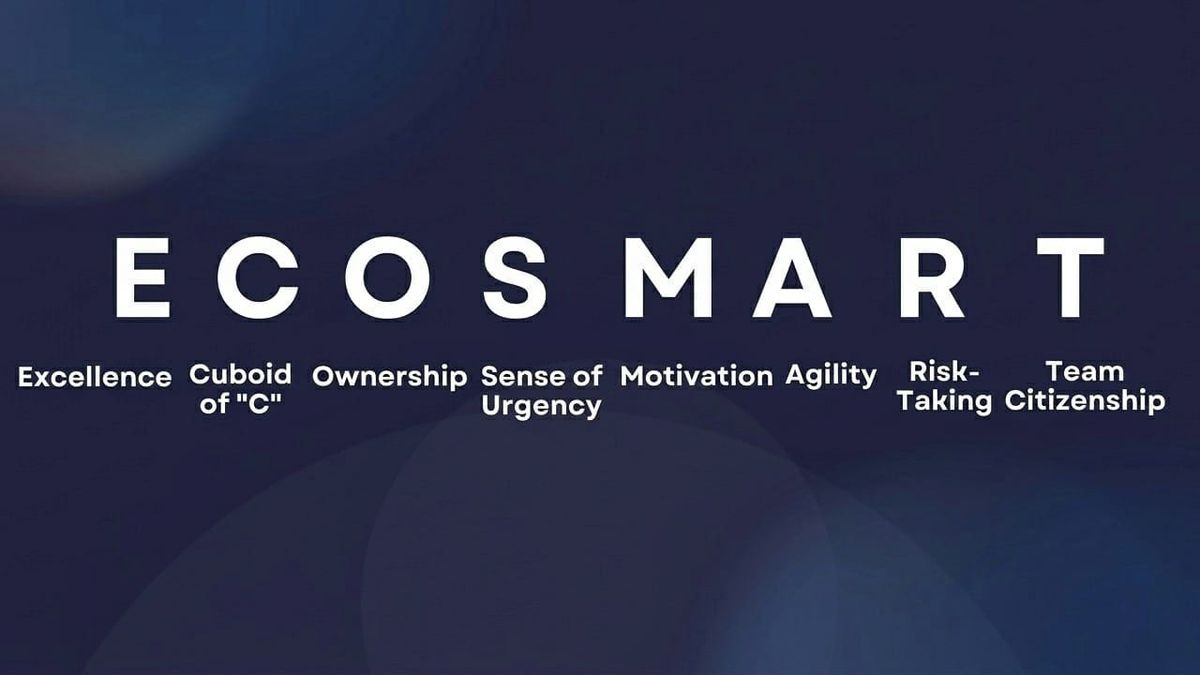
ECOSMART maps eight essential dimensions of organizational culture.
Together, these dimensions create the conditions for sustained performance, resilience through change, and meaningful innovation.
It can be used in two ways:
As a culture diagnostic: where are we strong? Where are we fragile?
As a leadership operating guide: what needs to be cultivated to unlock team potential?
The eight dimensions are:
E — Excellence
C — Cuboid of C
O — Ownership
S — Sense of Urgency
M — Motivation
A — Agility
R — Risk-Taking
T — Team Citizenship
Let's go through these 8 dimensions, one by one.
1. Excellence (The standard)
Excellence sets the baseline for how work is approached.
It reflects a commitment to high-quality thinking, effort, and output within real-world constraints such as time, resources, and uncertainty.
Teams that embed excellence into daily work tend to deliver consistently strong outcomes. Quality becomes a shared expectation rather than a situational effort.
2. Cuboid of C (The Human Architecture)
This is the most distinctive dimension of ECOSMART.
Most culture models present human attributes as a list. In practice, these attributes operate as an interconnected system. Each reinforces the others, and gaps weaken the whole.
I call this system the Cuboid of C.
At its center sits Customer Focus.
Customer Focus acts as the organizing principle. It gives direction to every other attribute and connects effort to impact.
Creativity without Customer Focus produces innovation for its own sake. Collaboration without Customer Focus becomes an internal alignment theater. Commitment without customer focus is effort without direction.
When this center is strong, other attributes align naturally around it.
Surrounding it are eight interconnected faces:
Creativity: The ability to generate new ideas, approaches, and solutions, not only in designated moments but as a daily habit
Curiosity: The genuine desire to understand customers, markets, technology, colleagues, and self
Change: The willingness to move beyond what worked previously in pursuit of what works next
Collaborative: The belief that collective capability exceeds individual contribution, supported by behaviors that make this real
Contextual: The ability to read situations accurately and adapt decisions, communication, and actions accordingly
Compassionate: The capacity to understand and respond to the human experience of others
Credibility: The trust earned through consistent delivery, honesty, and demonstrated expertise
Commitment: The sustained follow-through that converts intent into delivered outcomes
These attributes operate as a system.
A team strong in creativity but inconsistent in commitment generates ideas that never materialize. Strong collaboration without credibility creates alignment without trust.
Compassion without context leads to good intent without effective action.
The strength of the Cuboid depends on how well these attributes reinforce each other.
For Customer Success teams in particular, this model reflects daily operating conditions. It shapes whether relationships evolve into trusted partnerships or remain transactional.
3. Ownership (The accountability culture)
Ownership reflects how responsibility is taken within a team.
It shows up when individuals take charge of outcomes, including those that extend beyond defined roles. Ownership grows in environments where people feel safe taking responsibility and where leaders demonstrate accountability through their own actions.
Over time, this creates a culture where outcomes are shared, not assigned.
4. Sense of Urgency (The Execution Tempo)
A sense of urgency defines how an organization relates to time. It creates momentum toward outcomes without constant external pressure.
High-performing teams have an internal clock that keeps them moving toward outcomes without requiring external pressure to maintain velocity. They treat deadlines as commitments, not suggestions. They identify blockers early and remove them proactively.
The leadership challenge with Sense of Urgency is calibration. Too little and the organization drifts. Too much and it burns. Sustained urgency produces output without exhausting the system.
5. Motivation (The Energy Source)
Motivation is the connection between individual work and a meaningful outcome. It's the sense that what I do today matters — to my team, to our customers, to something larger than my task list.
Leaders influence this by connecting effort to purpose, recognizing progress, and creating an environment where intrinsic motivation can grow.
6. Agility (The Adaption Capability)
Agility is the organizational ability to sense change in the environment and respond faster than the environment changes. It involves sensing shifts early, learning quickly, and adjusting direction while maintaining coherence. In practice, this requires short feedback loops, distributed decision-making, and the ability to iterate without friction.
Teams with strong agility maintain momentum even as conditions evolve.
7. Risk Taking (The innovation Permission)
Risk-taking reflects how the organization approaches experimentation. It creates space for trying new ideas, learning from outcomes, and improving over time. Organizations that support thoughtful experimentation unlock greater creativity and progress.
8. Team citizenship (The community foundation)
Team citizenship binds the system together.
Internally, it reflects alignment between words and actions, honesty in difficult moments, and reliability across situations. It also extends outward. Teams exist within broader communities of customers, peers, and ecosystems.
High-performing teams contribute to these communities through knowledge sharing, mentorship, and participation. This builds trust both within the organization and beyond it.
How the Dimensions Work Together
ECOSMART operates as a system.
Excellence sets the standard.
The Cuboid of C, with Customer Focus at its center, provides direction.
Ownership and team citizenship build accountability and trust.
Sense of urgency and agility drive execution.
Motivation provides energy.
Risk-taking expands possibility.
Each dimension reinforces the others. Gaps in one create pressure across the system.
Alignment across all eight enables sustained performance.
Applying ECOSMART
The most powerful use of this framework is in leadership conversations.
Ask:
➜ Which dimensions are genuinely present in how the team operates today?
➜ Which ones exist more in intent than in consistent behavior?
➜ Which dimension, if strengthened in the next 90 days, would have the highest leverage?
The answers often reveal more about performance than metrics alone.
Final Thoughts:
ECOSMART was shaped by nearly two decades of observing what separates high-performance teams from groups that never fully come together. The years that followed tested these dimensions across rapid change, distributed work, and evolving technology.
The patterns held.
Teams that sustained performance showed strong team citizenship.
Organizations that adapted quickly had agility embedded in how they operated.
Environments that encouraged risk-taking enabled earlier experimentation.
One insight became clearer over time. Customer Focus operates at the center of the system, shaping how every other dimension connects to outcomes.
Culture is not peripheral to performance. It is the system through which performance happens.
ECOSMART offers a way to understand that system and work with it deliberately.
Which dimension of ECOSMART resonates most with your leadership experience, or feels hardest to build in practice?