Why Most SaaS Transformations Fail — and How to Fix It
Most organizations don't fail from a flawed strategy — they fail by building excellence in a few areas while leaving others underdeveloped, until the gaps compound.
Most organizations don’t fail because their strategy is flawed. They fail because they build excellence in a few areas while leaving others underdeveloped.
A company builds a strong product but struggles to deliver consistently. A team develops deep expertise but avoids change. A leader sets a bold direction but doesn’t build the capability required to execute it. Over time, these gaps begin to compound.
Sustainable performance comes from alignment across multiple dimensions, not isolated strengths.
I've seen this pattern repeatedly: working inside and alongside organizations navigating transformation for nearly 20 years across Fortune 500 enterprises, high-growth SaaS companies, and everything in between.
That's what led me to develop PROJECTILE.
What is Projectile?
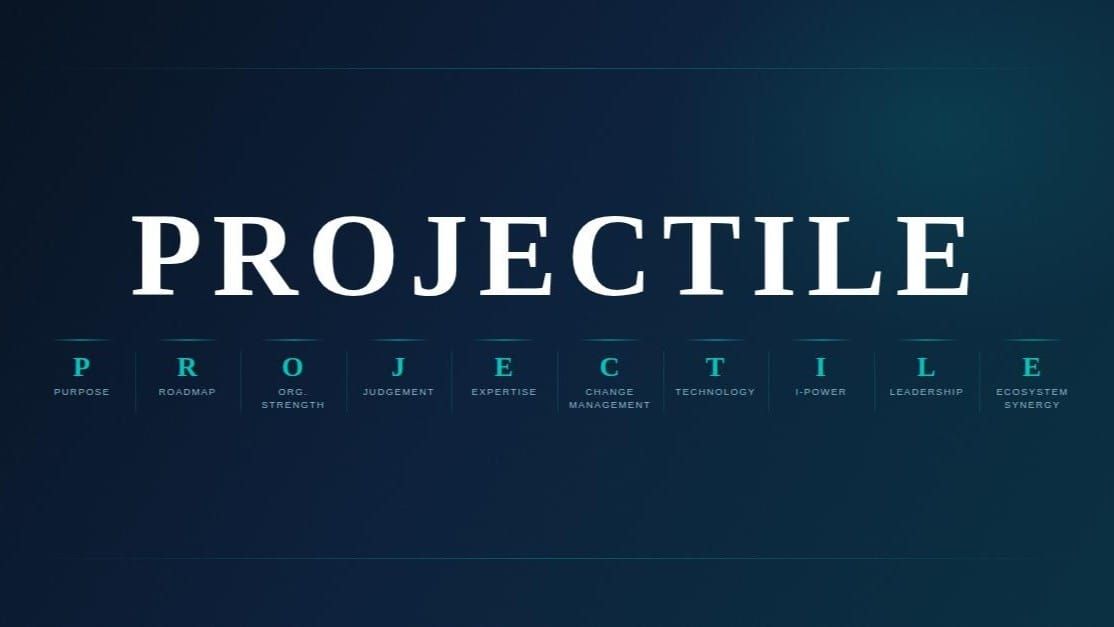
PROJECTILE is a leadership framework that maps the ten dimensions required to build a transformation-ready organization.
It took shape in 2020 after years of observing how organizations navigate transformation. It works as a diagnostic lens.
It helps leaders step back and assess the following:
Where the organization is strong
Where it is vulnerable
What needs attention before the next phase of growth
The ten dimensions include the following:
P - Purpose
R - Roadmap
O - Organizational Strength
J - Judgement
E - Expertise
C - Change Management
T - Technology
I - I-Power
L - leadership
E - Ecosystem Synergy
Let's walk through each one of them, one by one.
1) Purpose (The North Star)
Purpose answers a simple but critical question: "Why do we exist?"
Organizations with genuine purpose alignment make faster decisions, attract better talent, and sustain performance through adversity because their people know what they're optimizing for.
Without it, priorities shift constantly and execution loses focus.
Purpose anchors everything else in the system.
2) Roadmap (The Journey Architecture)
If purpose answers why, roadmap answers how we get there—and in what sequence.
A strong roadmap connects today’s actions with tomorrow’s capabilities. It provides sequence, clarity, and direction. It sequences transformation deliberately, building on what exists rather than replacing everything at once.
The most dangerous organizational state is high purpose with no roadmap. Passion without architecture creates chaos.
3) Organizational Strength (The foundation)
Organizational strength is what makes execution possible: culture, talent, processes, and your institutional knowledge.
This is the dimension leaders most frequently underinvest in during growth phases and most painfully discover during transformation.
You can have the best strategy in your industry and still fail if your organization doesn't have the cultural cohesion, talent density, and operational infrastructure to carry it.
Strong foundations take time to build and require consistent attention.
4) Judgement (The human discernment layer):
Judgment is the capacity to make sound decisions under ambiguity, incomplete information, and competing priorities.
It shows up in moments where data alone is insufficient.
Knowing when to pivot and when to stay the course.
Recognizing early signals before they become obvious.
Understanding when context matters more than raw information.
As AI increases analytical capability, judgment becomes more important. Organizations that combine data with human discernment tend to make better decisions over time.
Judgment can be strengthened through leadership development, experience, and a culture that supports thoughtful decision-making.
5) Expertise (The Capability Engine)
Expertise reflects the depth of knowledge and capability in areas that matter most for the organization’s strategy.
It raises a few critical questions:
Is expertise concentrated or distributed?
Is it evolving or becoming outdated?
Does it align with where the organization is going?
Organizations that continuously build and renew expertise stay relevant as their environment changes.
6) Change Management (The adoption architecture)
Change management is the discipline of making transformation actually land in behavior, in habit, in culture, and in results. It's the difference between an organization that announces change and an organization that lives it.
Many transformation efforts fall short here. The strategy is clear, and the tools are in place, yet adoption remains inconsistent. Sustained change requires attention to how people experience and adapt to it over time.
This dimension runs through every part of the framework.
7) Technology (The Amplification Layer):
Technology amplifies what already exists within the organization. Its impact depends on how well it is embedded into workflows and decision-making.
Organizations that connect technology to clear outcomes and integrate it into operating models tend to see stronger results. Others struggle to translate investment into value.
In this framework, technology sits alongside change management and I-Power because its effectiveness depends on adoption and continuous evolution.
8) I-Power (The innovation engine):
I-Power represents three interconnected forces:
Innovation: Generating new ideas, approaches, and capabilities
Integration: Connecting systems, teams, and initiatives into coherent value
Inspection: Evaluating what is working, what is not, and what needs to change
Balance across these three keeps the organization moving forward with clarity and discipline.
9) Leadership (The binding force):
Leadership connects all other dimensions.
It shapes how decisions are made, how people are developed, and how direction is maintained under pressure. Strong organizations tend to have leadership distributed across levels. Decision-making and ownership extend beyond the top.
This creates resilience and consistency in execution.
10) Ecosystem Synergy (The multiplier)
No organization succeeds in isolation. Ecosystem synergy is the ability to build, nurture, and leverage the network of partners, customers, communities, and platforms that amplify your organizational capability beyond what you can build alone.
Organizations that master ecosystem synergy don't just compete; they shape the competitive environment itself.
How the Dimensions Work Together:
PROJECTILE functions as a system.
Purpose and roadmap set direction.
Organizational strength and expertise provide capability.
Judgment and leadership guide decisions.
Change management and I-Power sustain momentum.
Technology amplifies outcomes.
Ecosystem synergy expands impact.
All ten dimensions operate simultaneously. Strength in one supports others. Gaps in one create friction across the system.
Alignment across these dimensions creates consistency and long-term performance.
Applying PROJECTILE as a Diagnostic
This framework is most useful as a leadership diagnostic.
A few questions help surface clarity:
Which dimensions are genuinely strong today, and do they align with future direction? Which dimensions feel fragile, and where could pressure expose gaps? What needs to be strengthened over the next 24 months?
The answers help determine not only where to invest, but also the sequence in which those investments should happen.
Decision-making has become more demanding. Technology has accelerated faster than adoption in many cases. Ecosystems have become central to growth.
The organizations that perform consistently are the ones that manage these dimensions together and adjust them with intent. The framework continues to serve as a practical way to think through that complexity.
Which dimension is currently the most challenging in your organization?