CS 2030 Part 3: Ratings Keep CSMs Steady. Outcome Pay Grows Accounts.
CS 2030, Part 3. Pooled, rating-driven bonuses keep CSMs steady but don’t grow accounts. Here’s how to pay the single account owner on retained and expanded ARR, all year, with fair targets for every book, without making them pushy
Part 3 of 10 · CS 2030 series
It's calibration week (a composite). One CSM spent the quarter rescuing a renewal that was heading for the door, then turned the rescue into an expansion. Another had a quiet book: no fires, no growth. Both land in the "strong performer" band, the bonus pool gets spread across the team, and the difference between their payouts is a few hundred dollars. Next quarter, the first CSM still does the right thing, because good people do. But the plan has told them it didn't matter much.
In 30 seconds
- The problem: CSMs are asked to own revenue but paid through pooled, rating-driven bonuses, so saving an account barely changes their pay.
- The evidence: variable pay is about 17% of US CSM pay, and only 44% of CS teams were paid for expansion in 2024, down from 57% (vendor surveys).
- The fix: pay the single owner in four layers, earn the incentive on retained and expanded ARR all year, and set targets for each account's starting point.
In Part 2, I argued that one person should own the existing customer. This part is about how to pay that person. Part 4, published alongside it, covers the leaders above them and what the whole model costs.
Merge the roles, merge the pay
If the account manager and the CSM become one owner, their pay has to merge too.
| Role | Typical base / variable | How variable is earned |
|---|---|---|
| Account manager | 50/50 to 60/40 | Commission on renewals and expansion |
| CSM | 80/20 to 85/15 | Pooled bonus, ratings, satisfaction scores |
| Single owner (CS 2030) | 60/40 to 75/25, by model | Outcomes on their own book, with guardrails |
The mix follows the Part 2 model: about 65/35 for a mid-market single owner, nearer 70/30 for an enterprise owner working with a specialist, nearer 80/20 for a pooled team covering the long tail. The aim is the account manager's line of sight to revenue with the CSM's protection for honest advice.
Commission fails CS. Better design doesn't.
CS leaders resist commission for good reasons: customers need honest advice, renewals get bought with discounts, and CSMs fight over the accounts most likely to grow. The research says the answer is design, not no incentive. When Safelite moved installers to piece rates, output per worker rose 44%, partly because the plan attracted more productive people (Lazear, 2000). When a Fortune 500 contact-lens maker removed quotas that encouraged reps to time their sales, revenue rose about 9% (Misra and Nair, 2011). The rule: pay structure shapes who joins and how they behave, so design it on purpose.
Myth: outcome pay is too complicated
Simple plans aren't simple. They move the complexity into calibration week, manager judgment and exceptions. Every rule below exists because a simple plan pays for the wrong thing.
| Real-world factor | What a simple plan does | The rule that fixes it | Win for the CSM | Win for the company |
|---|---|---|---|---|
| Renewals fall at different times of year | Pay drops off after the renewal quarter | Year-to-date net ARR, paid quarterly | A reason to keep working all year | No dead quarters |
| Some books are harder | Rewards luck, starts fights over accounts | Targets set for each book's potential and risk | A fair shot | Hard accounts still get covered |
| Renewals saved with a discount | Treats every discount the same, approved or not | Approved saves count at pre-discount value; undocumented discounts count in full | Not penalised for a hard save | Margin protected, discounts documented |
| Expansion that later churns | Pays for shelfware | Value gates and clawbacks | No pressure to oversell | Revenue that lasts |
| An exceptional year | Uncapped windfall, or a cap that invites sandbagging | A high expansion ceiling, excess to the team pool | Upside, and a reason to help others | A known maximum cost |
| The company beats plan | Leaders celebrate, CSMs see nothing | A shared kicker funded by growth above plan | A share of the upside | Pays only when revenue is there |
Pay in four layers, each on its own clock
The percentages are illustrative, not a benchmark.
| Layer | Share | Paid | What it rewards |
|---|---|---|---|
| 1. Secure base | 60–75% of cash | Monthly salary | Honest advice: "you don't need that yet" |
| 2. Individual outcome incentive | 20–35% | Quarterly, year-to-date | Retention, expansion that sticks, customer-confirmed value |
| 3. Shared and contribution kicker | About 5% | Annually | Company growth above plan, plus verified contributions |
| 4. Long-term ownership | Separate from cash | Vests over years | Staying, and the company's long-term value |
Layer 3 also rewards verified contributions beyond the book, such as a new-product lead that becomes revenue or a feature built from a CSM's insight once it shows adoption. Anything that can't be verified belongs in raises and promotion, not the formula.
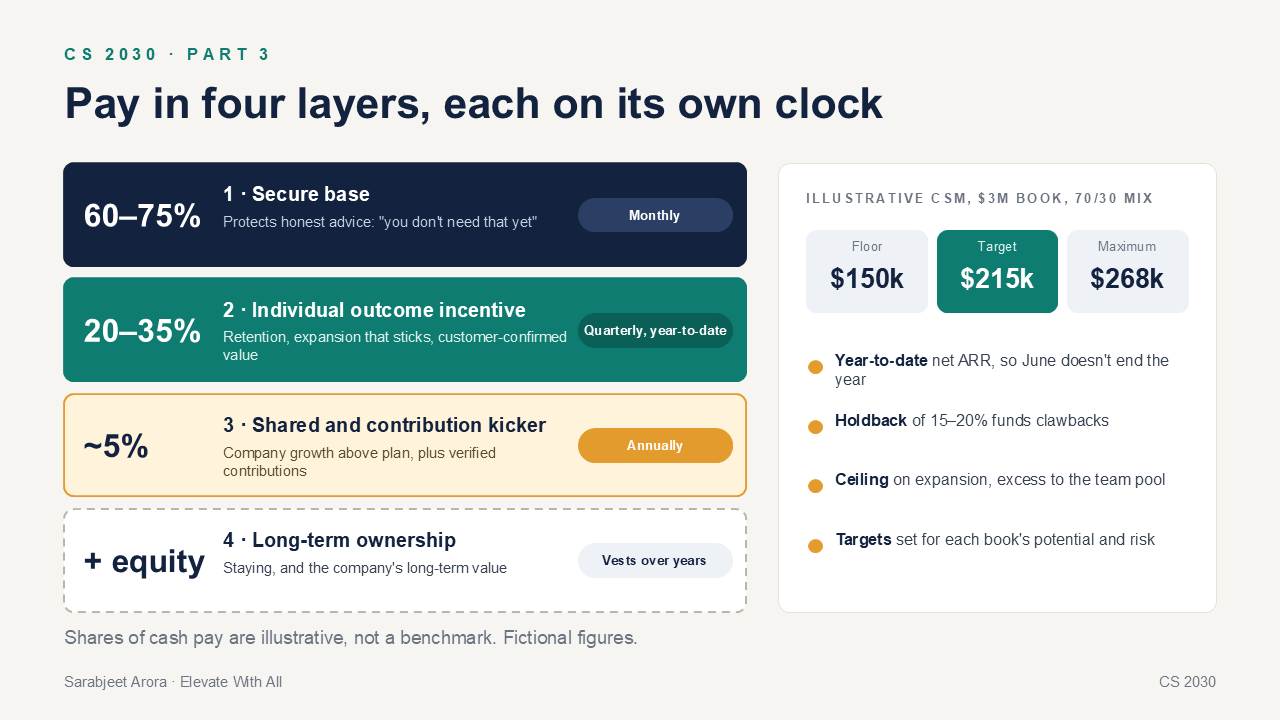
Four layers, each paid on its own clock. Fictional, illustrative figures.
Measure the incentive all year, so June doesn't end it
The individual incentive runs on the book's ARR:
- Retention: gross revenue retention, so renewals, churn and downgrades all count. An approved save counts at its pre-discount value: the CSM’s manager signs off up to about 5–10%, finance or a deal desk above that, with the customer’s written reason on file. An undocumented discount counts in full. It’s capped a little above target, because growth is where the upside is.
- Expansion: only growth that sticks, at a higher rate above target, up to a high ceiling. Anything above the ceiling flows to the team pool.
- Value milestones: paid when the customer confirms the outcome (Part 6).
Three timing rules keep it working all year:
- Paid quarterly, measured year-to-date: a downgrade in Q3 lowers the Q3 payment automatically.
- A 15–20% holdback: funds clawbacks at the year-end true-up, without asking for money back.
- A higher rate above target: hitting the number early is a reason to keep going.
A Fortune 500 sales-force study found quarterly bonuses lifted productivity more than annual ones, acting as "pacers," and commissions above quota sustained the best performers (Chung, Steenburgh and Sudhir, 2014). The rule: pay often enough to pace the year, and never let the top end go flat.
Objection answered: "Won't CSMs fight over the big accounts?"
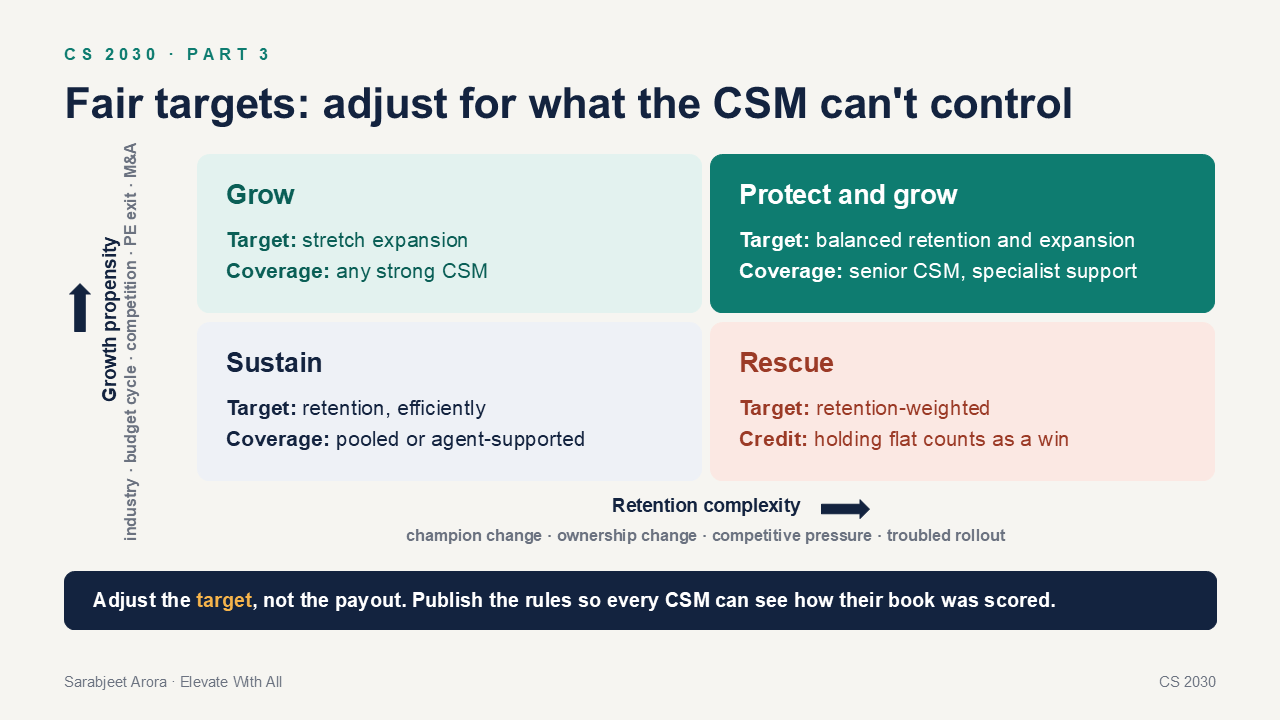
Not if the plan does two things. The rate comes from the target. Base pay follows the CSM's level, and the incentive rate is the target incentive divided by that book's target, so a bigger book gets a lower rate and the same dollars at target. The target comes from growth potential and retention risk, not ARR alone. A $5M book under a budget freeze, grown by $400k:
| Target as % of ARR | Target from growth potential | |
|---|---|---|
| Expansion target | $1.4M (28%) | $400k (8%) |
| Payout for $400k of growth | $6.3k, penalised for the customer's budget | $22k, the full target |
Targets are set at the start of the year and reset only for defined events: a merger, a PE exit, bankruptcy, a confirmed budget freeze, or the account changing owner. Who gets which book is Part 7.
From the CS 2030 Toolkit: one CSM, five different years
A fictional, illustrative CSM with a $3M book on a 70/30 mix. Target: 92% gross and 120% net revenue retention. Cash at target is $215k: $150k base, a $54k individual incentive and an $11k shared kicker.
| Year | Gross retention | Expansion | Net retention | Variable | Total cash |
|---|---|---|---|---|---|
| On plan | 92% | $840k | 120% | $65.0k | $215.0k |
| Quiet book | 96% | $150k | 101% | $53.7k | $203.7k |
| At-risk $400k renewal saved at a 15% discount | 90% (92% for pay) | $600k | 110% | $58.7k | $208.7k |
| Lost a $450k account | 85% | $840k | 113% | $38.0k | $188.0k |
| Expansion star | 94% | $1.5M | 144% | $97.7k | $247.7k |
The band is published up front: $150k floor, $215k at target, $268k maximum. An approved save now pays more than a quiet book, and both earn less than growth. Without a documented reason, a discount isn’t a save; it’s revenue leaking from the base. What this costs across a whole organization is in Part 4.
Team exercise: the simplicity test
Bring your current CSM plan to your next leadership meeting and ask:
- Explain: can a CSM explain it in 30 seconds?
- Calculate: can a manager work out the quarter's payout in 5 minutes?
- Budget: does finance know the maximum cost before the year starts?
What to do with this
- Put the plan on one page: the three numbers each CSM sees, the rules, and the floor, target and maximum.
- Re-score three books: set targets from growth potential and retention risk, and compare them with today's targets.
- Run one hard quarter through it: a renewal saved at a discount, an account lost, an expansion that churns. Check that each pays what it should.
The stance
Business is complex. Your pay plan either handles that complexity in its rules, or your managers handle it in calibration week. Pay for the outcome, set the target for the account, and protect the base. My view: if outcome pay raises churn or discounting within a year, the guardrails are wrong, not the principle.
Read Part 4 now: Outcome Pay for CS Costs Less Than You Think, on paying the leaders and what the whole model costs. All parts are on the CS 2030 hub.
Your turn
What does your CSM plan pay when a renewal is saved at a discount: more than losing it, or the same?
For members: all ten years, side by side
The same illustrative CSM, ten different years. Outcomes only; the plan's scoring rules stay in the toolkit.
The full ten-year table, from a windfall year to a clawback, is free for members.
If you'd like to pressure-test this against your own plan, message me on LinkedIn.
Disclaimer: this is a personal perspective, written in my own capacity. It is not connected to, endorsed by or based on any information from my employer. All pay figures, companies and scenarios are illustrative and fictional, not drawn from any employer's pay plans or data. Vendor surveys are used for direction, not as benchmarks. Views are my own.
Sources
- Lazear, E. P., Performance Pay and Productivity, American Economic Review 90(5), 2000
- Misra, S. and Nair, H., A Structural Model of Sales-Force Compensation Dynamics, Stanford GSB, 2011
- Chung, D., Steenburgh, T. and Sudhir, K., Do Bonuses Enhance Sales Productivity?, Marketing Science, 2014
- Everstage, CSM variable compensation, citing the 2024 Customer Success Salary report (vendor content; the 17% variable figure)
- ChurnZero, 2024 Customer Success Leadership Study: key findings (vendor research; the 44% and 57% figures)